

Which Welder To Use For Auto Frame Repair
Anti-Stutter and GCode Compression. Replaces G0/G1 with G2/G3 where possible.
Arc Welder: Anti Stutter and GCode Compression
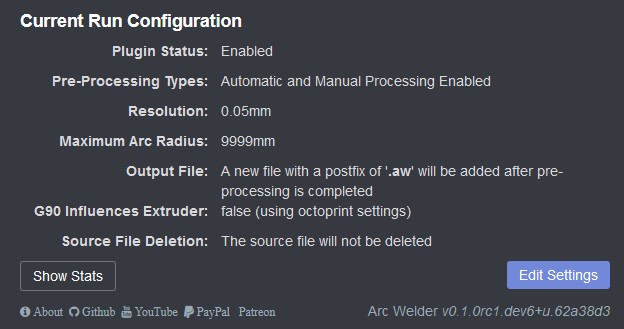
How To Utilize Arc Welder
Please read the readme file in the Github Repository for installation and usage instructions. I am planning to add a complete wiki for the plugin in the near future and will link to that here when it is complete.
Please notation that if you are using Python three, you may need to install the python3-dev bundle before Arc Welder volition install. This is detailed in the prerequisites section of the readme file linked to in a higher place.
Support Arc Welder Development
Please consider supporting my work past condign a patron, a Github Sponsor, or by sending me beer money via PayPal. Almost all of the donations go towards offsetting the toll of development, which is substantial. Plus, it always makes my twenty-four hours! If you cannot afford to go out a tip or just don't desire to, that is fine besides! Arc Welder is free and open up source afterward all.
What Arc Welder Does
Arc Welder attempts to supersede G0/G1 (linear move) GCodes with G2/G3 (arc motility) GCodes. This can substantially compress many GCode files and may reduce stuttering caused by sending many tiny movements in rapid succession over a slower serial connection. Hither is an instance of the earlier and later on of a unmarried layer of a cylinder with archimedean infill produced by PrusaSlicer:
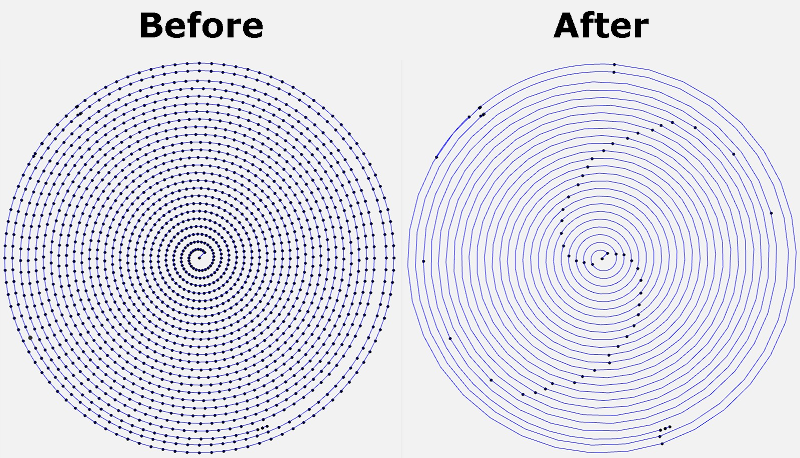
Each dot in the epitome above represents the start or endpoint of an extrusion. You can run across that the Afterwards GCode above has far fewer moves. The processed GCode is 76.one% smaller with 96.four% fewer extrusion/retraction commands than the original file. Detailed statistics are created and stored for each GCode file processed:
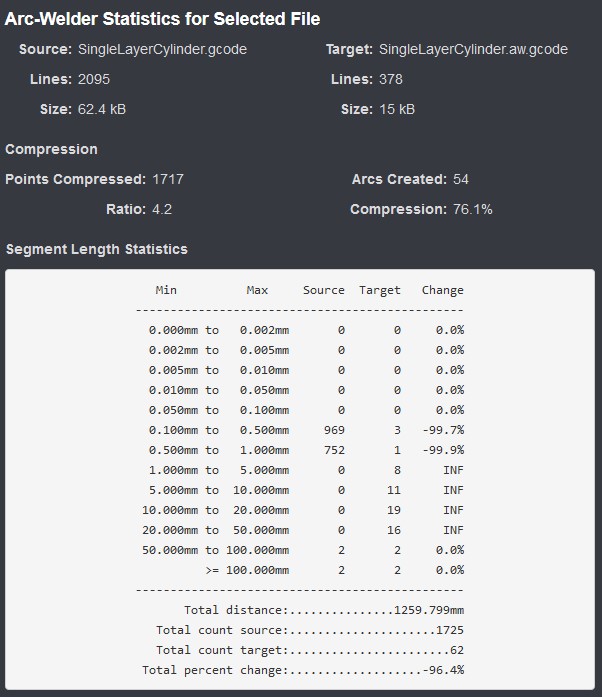
The results higher up are not typical since the source file is almost entirely circular. A improve existent world example, the first layer of the famous 3DBenchy, sliced with PrusaSlicer using archimedean infill is shown beneath:
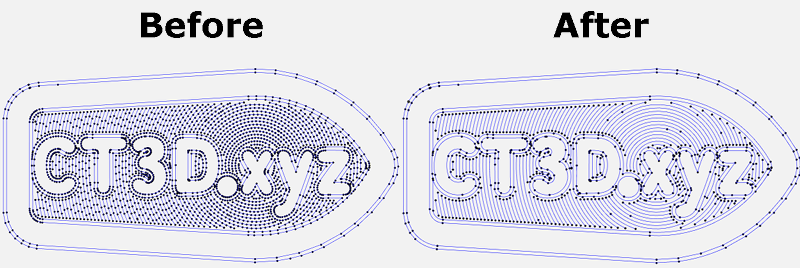
The result is a GCode file that is 56.two% smaller (2.iii compression ratio) with 75.0% fewer extrusion/retraction commands. In this example, Arc Welder shows a massive decrease in small extrusion moves between 0.01mm and 1mm in length:
Min Max Source Target Alter -------------------------------------------- 0.000mm to 0.002mm 0 0 0.0% 0.002mm to 0.005mm 0 0 0.0% 0.005mm to 0.010mm 0 0 0.0% 0.010mm to 0.050mm 7 one -85.seven% 0.050mm to 0.100mm 29 6 -79.iii% 0.100mm to 0.500mm 1342 74 -94.5% 0.500mm to one.000mm 810 114 -85.ix% 1.000mm to 5.000mm 145 341 135.ii% 5.000mm to 10.000mm 1 25 2400.0% 10.000mm to 20.000mm ii fourteen 600.0% xx.000mm to 50.000mm 8 eight 0.0% 50.000mm to 100.000mm 2 ii 0.0% >= 100.000mm 2 2 0.0% -------------------------------------------- Total distance:............1929.879mm Total count source:..................2348 Full count target:...................587 Total percent change:................-75.0% How Arc Welder Works
Arc Welder reads each GCode in the source file, searching for three extrusion or retraction commands in a row. It adds adds these points to a special shape detection course that determines if the collected points can be represented by an arc command (G2/G3). Once an arc is detected, Arc Welder compares the original GCode path with the resulting arc command to ensure that any departure is within the specified resolution (by default, +-0.025mm). Arc Welder will continue to add new points to the arc until it detects either a meaning deviation from the original GCode or a change in the printer's country (a new layer, a feedrate or kickoff change, etc.). Information technology will then pull off the final point from the arc, output the contradistinct G2/G3 command, and keep to process the file. The resulting GCode will non vary from the source file by more than than half of the specified resolution, which is configurable. Hither is a rudimentary illustration:
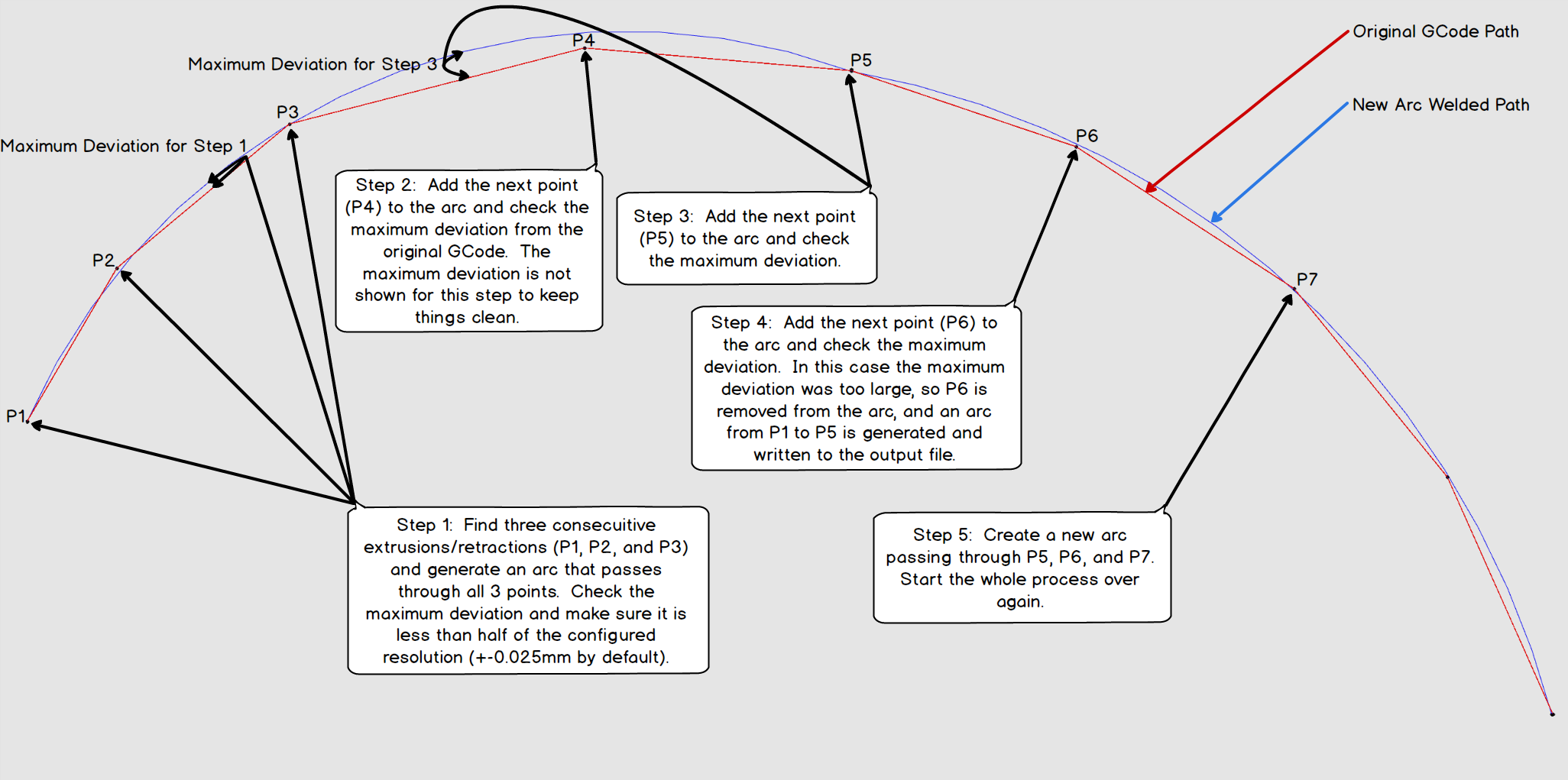
In the example above, Arc Welder has created ii arcs. The first arc starts at P1 and ends at P5 on the bluish line. The original path is shown in red. In this example Arc Welder first adds iii consecutive points (P1-P3) to its shape detection form and determines that the generated arc does not deviate significantly from the original path. It then adds P4 and P5, once again detecting no meaning deviation. However, at P6, the detected difference exceeds the maximum, then P6 is not added, and an arc is generated that replaces P1-P5. Arc Welder then starts a new arc from P5, P6, and P7 and continues the process. Note: The endpoints of every arc will ALWAYS line up exactly with the original GCode.
It is important to annotation that the example above is zoomed Manner in so that the deviation looks very big. It is, in fact, extremely small and near impossible to run across with the naked center. Y'all can customize the resolution in the plugin settings if 0.05mm (+- 0.025mm) is besides large for you.
Arc Welder Plugin Features
- Customizable Resolution - You control the maximum allowable deviation from the original tool path. Higher values volition result in more than compression but more than difference. Lower values will produce more authentic GCode only less compression. The default value of 0.05mm (+- 0.025mm) produces fantabulous results in about cases. I would recommend a lower value merely for extreme cases, like extremely high resolution models with modest nozzles and very depression layer heights. Values higher than 0.05 are not recommended.
- Automated and/or Manual Processing - Arc Welder can be configured to automatically process newly added file or to let manual processing via an integration with the OctoPrint file manager. Yous can enable one or both of these methods depending on your preference.
- Rename or Overwrite the Source File - Choose to go along the original source GCode file or replace it entirely with the arc-welded file. You tin likewise add a custom prefix or postfix to the output file.
- Delete the Source File After Processing - You can create a new file and accept Arc Welder delete the original file automatically in virtually cases.
- Come across Detailed Conversion Statistics - Arc Welder creates and stores statistics for each converted file, including compression percentage and ratio, source/target file size, and line count, besides every bit a detailed comparison of extrusion/retraction counts at various lengths between the source and target file. Y'all tin view statistics for any arc-welded file past selecting it in the file manager or past clicking on the icon within the file manager.
- Detailed Conversion Progress Bar - See existent time progress info equally Arc Welder processes your file, including several useful statistics. You lot tin abolish the conversion at any time.
- Enable/Disable Notifications - Tired of popup messages? Plow them off in the settings.
- Advanced Logging Settings - You can command logging from inside the plugin's settings page if you run across issues. You can even delete the existing log(s) completely.
- Restore Plugin Defaults - Hands restore the default settings if you run across trouble.
- Receive Notifications for New Development or Maintenance Release Candidates - Get early notifications about new features and bug fixes. Help contribute to the project! Arc Welder also supports plugin-specific release channels in a future version of OctoPrint (if that feature is eventually released).
Arc Welder Library and Panel Application
The core of the Arc Welder plugin is a set of libraries written in c++ based on code that was originally designed for the Octolapse plugin. This lawmaking allows Arc Welder to parse GCode and decide the printer's position and extruder state after each command. Since the code is written entirely in c++, it is orders of magnitude faster than similar code written in Python. The complete source, besides as a console version and inverse processor (convert G2/G3 to G0/G1), can be constitute here. In that location are also pre-compiled binaries, though I've not gotten them to work properly in MacOS or in some flavors of Linux. There are currently no GitHub hosted runners for whatsoever Raspberry Pi. I am working on these issues.
Using the console awarding, it is possible to arc-weld files via most slicers every bit a mail-processor. However, all slicers that I have tested except for Simplify 3D fail to correctly visualize the G2/G3 commands. Simplify 3D does seem to work perfectly for this, but other slicers make it wait similar the GCode is faulty. Keep that in mind if you plan to integrate the Arc Welder Console Awarding with your slicer.
Firmware Considerations
Your printer's firmware must exist capable of press G2/G3 commands to use the GCode produced by Arc Welder. Additionally, arc support must be enabled and properly configured. Firmware support varies, and many older versions produce arcs less accurately and more slowly than expected.
Marlin
Marlin has supported arc commands for a long fourth dimension. All the same, starting with version 2.0.six arc support has been profoundly enhanced. I recommend y'all upgrade to at least this version before using Arc Welder considering your experience will exist much ameliorate. Arc back up must be enabled in your Configuration_adv.h file.
For recent versions of Marlin (2.0.6 and to a higher place), you can send an M115 to come across if your firmware has ARC_SUPPORT enabled. For before versions you can send an empty G2 or G3 command. If your printer responds with unknown control, arc support is not enabled.
If your printer is running a fork of Marlin, but arc support is not enabled or is buggy, I recommend creating an issue within the fork's repository.
"A plugin that can catechumen curves into arcs volition be massively welcome and should make a great comeback in performance and print results."
Scott Lahteine- Creator of Marlin Firmware
Prusa Firmware
Prusa'due south fork of Marlin does support G2/G3 commands, withal the default settings tin produce abrupt corners for very pocket-sized arcs. I've merely noticed this in a few of my test prints, so it is not a particularly common issue. You lot should be able to see it on the roof of a Benchy if y'all expect closely. Reducing the MM_PER_ARC_SEGMENT setting slightly can correct this just can as well innovate stuttering. Reducing the value massively (say to 0.1mm) will introduce a LOT of stutter and is NOT recommended. Please note that adjusting this setting currently requires a manual firmware recompile.
I have been toying with the firmware and have submitted a pull request to raise the capabilities, but information technology hasn't fabricated it into the firmware however and may require further modifications. I am planning to add some enhancements from Marlin ii.0.6 as well. I likewise added some new GCodes for adjusting arc interpolating and for retrieving the firmware settings for arc generation. You lot can view the pull asking here. Feel free to give this pull request a thumbs upwardly, only realize that information technology needs some piece of work and that the skillful folks at Prusa Research take a lot on their plates.
Likewise, some very old versions of Prusa'southward firmware (I'm not sure exactly how old) do not support bed leveling adjustments during arc movements. Delight make sure you are using a contempo version of the firmware so that interpolated movements are properly leveled.
Klipper
Klipper seems to handle G2/G3 commands with ease, as long equally the GCode_arcs config department is enabled. G2/G3 support was added on September 13, 2022, and then make sure you update Klipper if you lot are using an older version.
Other Firmware
Though G2/G3 support is not universal, nor are all implementations equal, it is relatively easy to test. Yous tin can do then in the OctoPrint terminal by sending the the post-obit commands, ane at a time:
G90 G28 X Y G0 X0 Y0 G2 X40 I20 If your printer supports arc commands, it should move across a small-scale arc from the origin. Please experience gratuitous to let me know if your firmware supports arc movements, and I may add it to the list.
Alarm: The above GCode has not been tested on all printers. Please use it with caution and report any issues here.
Other Firmware Considerations
Most firmware will convert G2/G3 commands to many small segments through a process called interpolation. The length of these segments varies by implementation. In most cases the interpolated segments are much closer together than the linear segments you lot will find within your GCode file, simply information technology's impossible to know for sure without examining the firmware in particular.
All firmware that I am aware of will inscribe these interpolated segments within the arc. These segments volition exist entirely within the arc, only touching it at the endpoints. This will reduce the boilerplate radius slightly. In most cases, this effect is minimal and has no practical impact. However, in some odd cases, like a snap fitting that is extremely sensitive to changes in diameter, the effect may be noticeable. The smaller the interpolated segments (all firmware controlled), the less of an effect there is. In general, it will be a much smaller outcome than normal variations in filament diameter. I hope to find a solution to this problem.
G2/G3 support is not perfect at the moment, but I suspect things will commencement to improve every bit they become more common. If you are willing and have the skills to better G2/G3 support in whatever way, delight do!
License
View the Arc Welder license.

Source: https://plugins.octoprint.org/plugins/arc_welder/
Posted by: talbothistion.blogspot.com
0 Response to "Which Welder To Use For Auto Frame Repair"
Post a Comment